
Moonshot released Kimi K3’s weights on 27 July. The download is 1.56 TB. Here’s what running it in production actually requires, and why most enterprises shouldn’t. Accurate as of 29 July 2026
On 27 July, Moonshot AI released the weights for Kimi K3: 2.8 trillion parameters, the largest openly available model in the world. Within hours the conclusion was everywhere: another win for open AI. Download the weights. Run them yourself. Stop paying token fees.
The first part is true. The Hugging Face repository is public. Ninety-six safetensors shards, roughly 1.56 TB, and it is genuinely a frontier model. Kimi K3 is the highest-ranked open-weight model on the Artificial Analysis Intelligence Index at the time of writing, within a few points of the leading closed models.
The second part is where enterprises are about to lose a lot of money.
Because open weights are free. Operating them is not. And the distance between “the file is on Hugging Face” and “this is serving production traffic inside our compliance boundary” has never been wider than it is with this model.
That gap is the actual story of Kimi K3, and it is where the next phase of enterprise AI gets decided.
1. Downloading the model is the last easy thing that happens
Start with the arithmetic, because it settles the argument faster than any strategy discussion.
At 4-bit precision, 2.8 trillion parameters is about 1.4 TB of raw weights. The shipped repository is 1.56 TB once you account for scaling factors and the layers held at higher precision. That number is not a forecast or a benchmark. It is a file size, and it does not change.
Now put it on hardware:
| GPU | HBM per card | 8-GPU node | Holds 1.56 TB of weights? |
|---|---|---|---|
| H100 | 80 GB | 0.64 TB | No, needs ~20 cards |
| H200 | 141 GB | 1.13 TB | No, needs ~12 cards |
| B200 | 180 GB | 1.44 TB | No, needs ~9 cards |
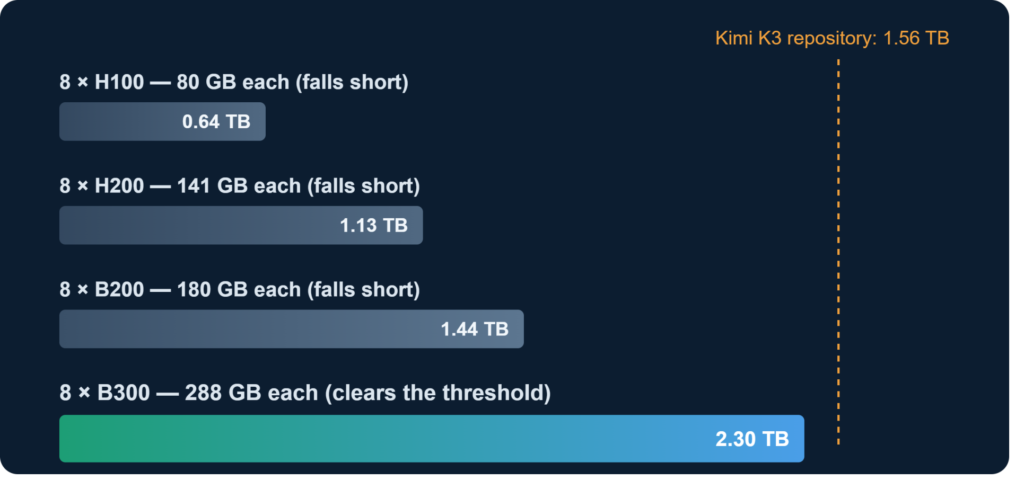
Figure 1. Why Kimi K3 exceeds the memory capacity of a single 8-GPU server.
At 1.56 TB, the weights exceed what a fully loaded eight-way B200 node can hold (1.44 TB) before a single token of KV cache exists. Newer silicon clears the bar: vLLM’s own K3 recipe names a single-node validation baseline of at least 8× GB300, with an AMD path of 8× MI355X or MI350X. So a single node is possible, on the right hardware, and out of reach on anything a year older. And with a 1,048,576-token context window, KV cache is not a rounding error.
Moonshot’s own guidance is consistent with that: they recommend deploying K3 on supernode configurations of 64 or more accelerators, because inference efficiency depends on a large high-bandwidth communication domain. That figure is a production-efficiency recommendation rather than a minimum viable topology, and Moonshot has not published a minimum GPU count, validated GPU list, or required interconnect.
That’s the difference between a model you can experiment with and one you can economically operate.
There is a second, subtler cost. Kimi Delta Attention, the hybrid linear attention mechanism K3 is built on, breaks conventional prefix caching badly enough that Moonshot had to contribute a new implementation to vLLM alongside the release. If your inference stack was validated three weeks ago, it was validated against assumptions this model does not hold.
For most enterprises, that changes the question from “can we avoid API costs?” to “what workload could possibly justify infrastructure at this scale?”
2. Most organisations should not self-host Kimi K3
We operate private GPU infrastructure for a living, so this is not a comfortable sentence to write. It is still the right advice.
The reason is utilisation, and it is structural rather than a function of this quarter’s GPU prices.
An API bills you per token. A self-hosted deployment bills you for wall-clock time: every hour those 64 accelerators exist, whether they are serving one request or ten thousand. Self-hosting therefore only wins when demand is high, sustained and predictable enough to keep expensive hardware busy. A cluster running at 5% utilisation costs roughly twenty times what the same work costs at 100%.
Two release-specific details sharpen this further:
- K3’s API pricing is $3 per million input tokens and $15 per million output, dropping to $0.30 on cache hits. That is Claude Sonnet territory, not the bargain-basement pricing people expected from a Chinese open release. The API is not the expensive option here.
- K3 always reasons, and reasoning cannot be disabled at any effort setting. On the API that inflates your output bill. On self-hosted infrastructure it does something worse: those tokens consume GPU-seconds you have already paid for, so effective throughput per accelerator is lower than a comparable non-reasoning model. That pushes your break-even volume up, not down.
None of this makes Kimi K3 a bad model. It is an outstanding one, and that is precisely why it illustrates the point so clearly. The most capable open model ever released is also the clearest demonstration that “open weights” and “you can run this” are separate claims.
3. When self-hosting genuinely wins
Self-hosting is not a bad strategy. It is a strategy with entry conditions. Here are the ones that actually hold, in rough order of how often they decide the question:
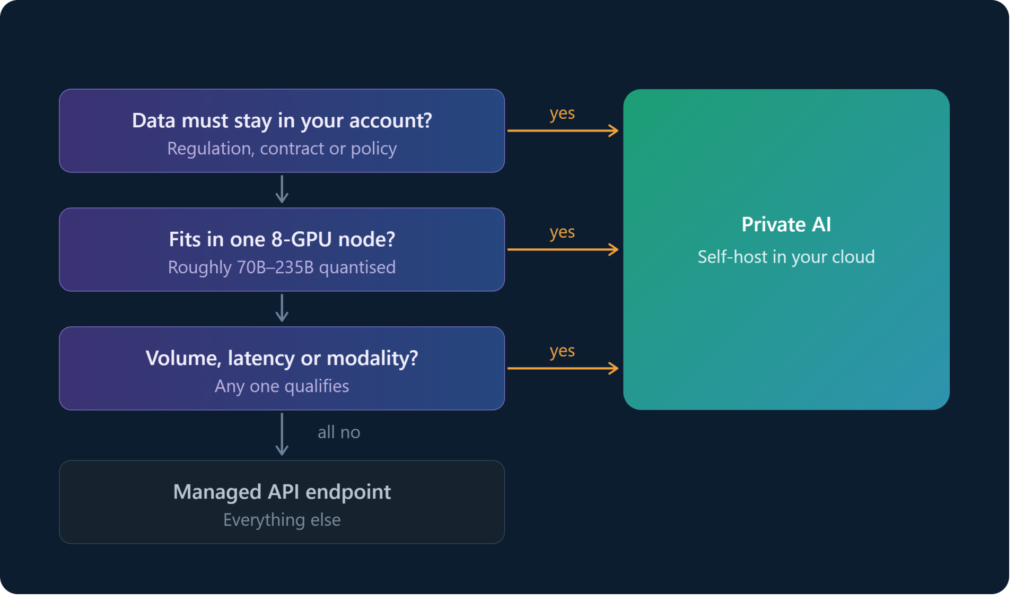
Figure 2. A practical decision tree for self-hosting frontier models.
1. A hard data-residency or sovereignty constraint. If regulation, contract or internal policy says the data cannot leave your environment, the economics are secondary. Compliance is not a cost optimisation. This is the single most common reason our customers run private GPU.
2. The model fits on one node. This is the practical dividing line. A model that fits in a single 8-GPU server is an ordinary deployment: no multi-node interconnect design, no expert-parallel communication tuning, no supernode procurement. In current hardware terms that is roughly the 70B–235B class, quantised. Below the line, self-hosting is routine engineering. Above it, you are running a specialist infrastructure programme.
3. High, sustained, predictable volume. Not peak volume, sustained. Batch document processing, contract review pipelines, always-on internal assistants. Bursty or exploratory workloads belong on an API.
4. Modalities where token billing breaks down. Image and video generation, high-volume vision, real-time voice. Per-token pricing was designed for text and behaves badly here. This is where private GPU wins on pure economics rather than on compliance.
5. Latency floors that a network hop cannot meet. Sub-100ms inference loops, production-line vision, real-time voice, need the model close to the workload.
If none of those apply, use the API and spend your engineering time on the product. If two or more apply, run the numbers properly rather than by intuition.
Worth noting what the honest answer usually looks like: a mid-size European enterprise self-hosts a 70B-class fine-tuned model for its sensitive workloads and calls a managed endpoint for everything else. Hybrid is not a compromise. It is the correct architecture for most organisations, and it is what the majority of our deployments actually look like.
4. The same model can have two completely different compliance profiles
Since the release, one question has come up more than any other from European teams:
Can we use a Chinese frontier model without sending our data to China?
The answer depends entirely on how you use it, and the distinction is sharper than most people assume.
Calling the Kimi API means your prompts, documents and context are processed on Moonshot’s infrastructure, with all the transfer, residency and legal consequences that follow. Running the open weights inside your own AWS, Azure or Google Cloud account means the model is a file executing on hardware you control. Nothing leaves your account. Same model, same weights, opposite compliance posture.
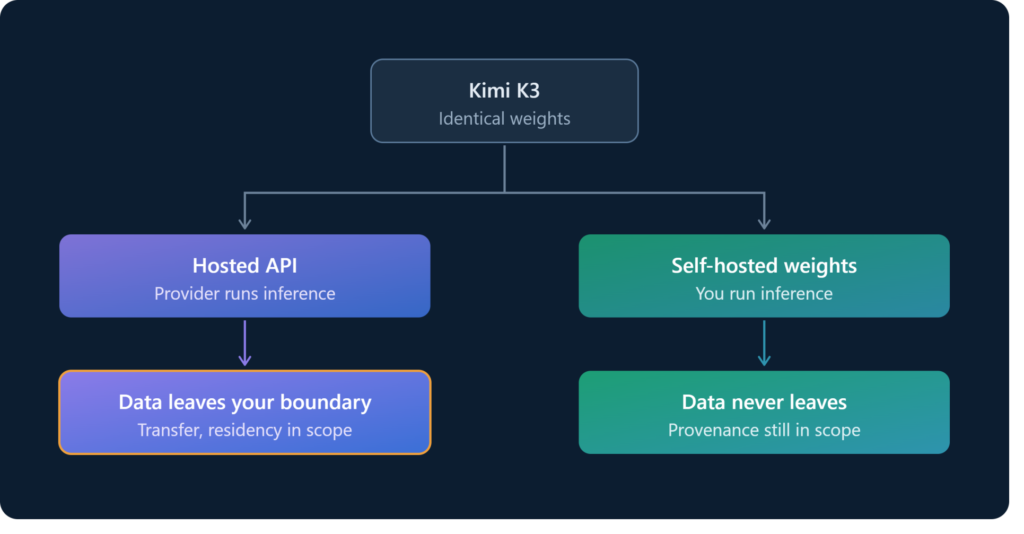
Figure 3. The same model can have different compliance characteristics depending on where inference runs.
That distinction matters far more to a regulated enterprise than any benchmark ranking.
But it does not solve everything, and it would be dishonest to imply otherwise.
Self-hosting removes the data transfer question. It does not remove EU AI Act deployer obligations, model provenance review, or internal policy on model origin. Some organisations will conclude that no PRC-origin model clears their bar regardless of where it runs. That is a legitimate position, arrived at for reasons architecture cannot address.
Self-hosting also does not eliminate licensing obligations. Reporting on K3’s shipped terms points to revenue-threshold conditions and attribution requirements rather than a straightforwardly permissive licence. One analyst classifies commercial use as requiring a separate agreement with Moonshot. Read the licence in the repository before you build a product on these weights, rather than relying on launch-week summaries, this article included.
The point is that self-hosting turns “can we use this model?” into an actual decision with reviewable inputs, rather than a reflex triggered by where an API endpoint happens to sit.
5. Where this ends up
Every organisation that reaches the self-host branch of that decision discovers the same things in the same order. Getting the model to return a token is a good afternoon. Then staging and production drift apart and nobody knows which version served last Tuesday’s answer. Then the GPU bill arrives and no one can attribute it to a team or a workload. Then a model version regresses and there is no rollback path, because nobody built one.
Downloading weights was never the project. Building an environment that survives contact with production is.
We didn’t design XePlatform from a market analysis. We built it because those four failures showed up in every enterprise deployment we touched, in that order, every time. So we automated the answers: environment parity enforced before promotion, GPU scheduling that scales to zero when idle, per-workload cost telemetry, and canary rollout with auto-rollback. It runs inside your cloud account, on infrastructure billed to you, with no data-plane access on our side, whether that’s Private AI on your own GPU, Managed AI endpoints, or both.
Kimi K3 isn’t the story. The story is that frontier models are becoming commodities while the ability to operate them is not.
Open weights are free. Operating them isn’t. That gap is now the enterprise problem.
Start with the number, not the demo
If you are evaluating open-weight models, the first question is not can we run it. It is at what volume does running it ourselves make financial sense, and that is arithmetic, not opinion.
→ Try the AI Infrastructure Break-Even Calculator. Compare API token spend against private GPU deployment for your actual workload volume.
If the calculator suggests Private AI is viable for your workload, we’ll happily review the assumptions with you. If it suggests the opposite, that’s a useful result too, and it cost you nothing.
Frequently asked questions
Can Kimi K3 be self-hosted?
Yes. Moonshot released the full weights on 27 July 2026, roughly 1.56 TB across 96 safetensors shards. Self-hosting is technically possible for any organisation with sufficient GPU capacity, but “possible” and “practical” are different questions. Check the repository licence before commercial deployment, as the terms are not straightforwardly permissive.
How many GPUs does Kimi K3 require?
Moonshot has not published a minimum. The repository is roughly 1.56 TB, which exceeds the memory of a fully loaded 8×B200 server (1.44 TB) before any KV cache. Newer silicon clears it: vLLM’s K3 recipe names a single-node validation baseline of at least 8× GB300, or 8× MI355X/MI350X on AMD. Moonshot separately recommends supernode configurations of 64 or more accelerators for efficient production inference, which is a performance recommendation, not a floor.
Should I self-host Kimi K3 or use the API?
For most organisations, the API. Self-hosting bills wall-clock time rather than tokens, so it only wins at high, sustained utilisation. Self-hosting becomes the right answer when you have a hard data-residency requirement, sustained high volume, latency floors below 100ms, or token-hostile modalities like image, video or real-time voice.
Does self-hosting a Chinese model solve data sovereignty concerns?
Partly. Running open weights in your own cloud account means no prompt or document data reaches the model provider, a materially different position from calling the hosted API. It does not address EU AI Act deployer obligations, model provenance review, or internal policies restricting model origin, all of which remain live questions.
What size model is practical to self-host?
As a rule of thumb, one that fits in a single 8-GPU node, currently around the 70B–235B class when quantised. Below that line, self-hosting is ordinary engineering. Above it, you are running a multi-node infrastructure programme with expert-parallel communication tuning and specialist procurement.
Operator’s Notes is our series on what frontier AI releases actually require in production. Next up: the Qwen and DeepSeek open-weight releases, and whether either lands below the single-node line.
Sources
- Moonshot AI, Kimi K3 launch post and technical blog (16 July, 27 July 2026), on architecture, quantization-aware MXFP4 training, and the 64+ accelerator supernode recommendation.
- Unite.AI, “Moonshot Opens Kimi K3 Weights Under a Revenue-Tiered License” (29 July 2026), on the parameter count, active-parameter routing, weight-release date, and licence terms.
- BenchLM.ai, “Kimi K3: The Open Model Closing the Gap” (28 July 2026), on the shipped repository shard count and API pricing.
- TechTimes, “Kimi K3 Open Weights Arrive Sunday” (25 July 2026), on raw memory footprint at MXFP4 precision and hardware-vendor support (Blackwell, MI400).
- Amplifi Labs, “Kimi K3: The Complete Guide to Moonshot AI’s 2.8T Model” (22 July 2026), on Kimi Delta Attention, the vLLM prefix-caching contribution, and always-on reasoning behaviour.
- TECHi, “Kimi K3 Is Cheap to Call, but the Weights Are Not Here” (24 July 2026), on the gap between model-level efficiency claims and deployment-level infrastructure constraints.
- South China Morning Post, “Moonshot’s Kimi K3 triggers Silicon Valley debate over bans on Chinese open source models” (29 July 2026), on the public release and non-Nvidia hardware ecosystem context.
- Artificial Analysis, Intelligence Index rankings (accessed 29 July 2026), for K3’s standing among open-weight models.
Figures and analysis in this article represent our own calculations based on publicly reported specifications. Verify current pricing, licensing terms and hardware requirements directly with Moonshot AI and the Kimi K3 Hugging Face repository before making deployment decisions, as these details may change after publication.