
Almost every company has built an AI demo by now. Very few have gotten AI running reliably across engineering, support, finance, sales, and legal at the same time.
That gap isn’t about model quality. It’s about infrastructure, the unglamorous layer of gateways, routing, GPUs, observability, and governance that determines whether an AI feature that impressed a demo audience can actually survive contact with a thousand real users, a compliance review, and a budget cycle.
This is a look at what that infrastructure actually consists of, why most companies are still missing it, and what building it deliberately looks like.
Why Most AI Projects Never Reach Production
The scale of AI adoption and the scale of AI value realization have become two different stories. McKinsey’s 2025 State of AI survey found that 88% of organizations now regularly use AI in at least one business function, and 72% use generative AI specifically , up from 33% just a year earlier. Enterprise appetite for AI is not in question.
What happens after that initial adoption is a different picture. MIT’s Project NANDA research on the “GenAI Divide” found that roughly 95% of enterprise generative AI pilots fail to deliver measurable P&L impact , and notably, the researchers traced this not to weak models, but to a learning and workflow-design gap: teams built demos without building the surrounding systems needed to capture value at scale. Only a small fraction of evaluated tools ever made it to production use.
The pattern shows up in specific, well-documented cases too. Starbucks retired an AI inventory system across more than 11,000 stores after it repeatedly miscounted stock, with employees spending more time correcting it than manual counting would have taken. Separate survey data found that a majority of companies that deployed customer-facing AI agents had to roll at least some of them back.
None of these are stories about bad AI. They’re stories about AI deployed without the infrastructure layer that makes production operation possible: no clear routing logic for which model handles which task, no cost attribution, no governance checkpoint before an agent takes an action, no observability into what’s actually happening once it’s live.
The pilots that survive tend to share the same trait: someone built the infrastructure around the model before scaling it, not after.
The Layers of Enterprise AI Infrastructure
Most conversations about enterprise AI focus entirely on one layer , the model. Which one is smartest, which one is cheapest, which benchmark it wins. That’s a real question, but it’s the easiest one to answer and the least differentiating one to build a strategy around, because model choice changes every few months and everyone has access to the same handful of frontier options.
The layers that actually determine whether AI works reliably at scale sit above and below the model itself:
-
- Applications : the actual product surface: chatbots, copilots, internal tools, agents. This is what users see, and it’s usually where companies start and stop thinking about “AI infrastructure.”
-
- AI gateway : a single control point that every AI request passes through, regardless of which application or team originated it. Authentication, rate limiting, and policy enforcement live here.
-
- Routing : the logic that decides which model handles which request. Not every task needs a frontier model; a well-built routing layer sends routine queries to cheaper, faster models and reserves expensive ones for tasks that need them.
-
- Models : the actual foundation models, whether a frontier API model, a self-hosted open-weight model, or both. The layer everyone talks about, and the one that matters least on its own.
-
- GPU infrastructure : the physical or virtual compute self-hosted models run on: provisioning, autoscaling, spot vs. reserved capacity, and the cost and capacity planning that comes with owning infrastructure instead of renting it per call.
-
- Observability : logging, tracing, and monitoring for AI-specific failure modes: hallucination rates, latency spikes, cost per request, drift in output quality over time.
-
- Governance and security: access controls, audit trails, data handling policies, and the ability to prove , not just assert , that a deployment meets a given compliance bar.
A production-grade AI deployment touches every one of these layers. A demo touches exactly one: the model. That gap is the whole story.
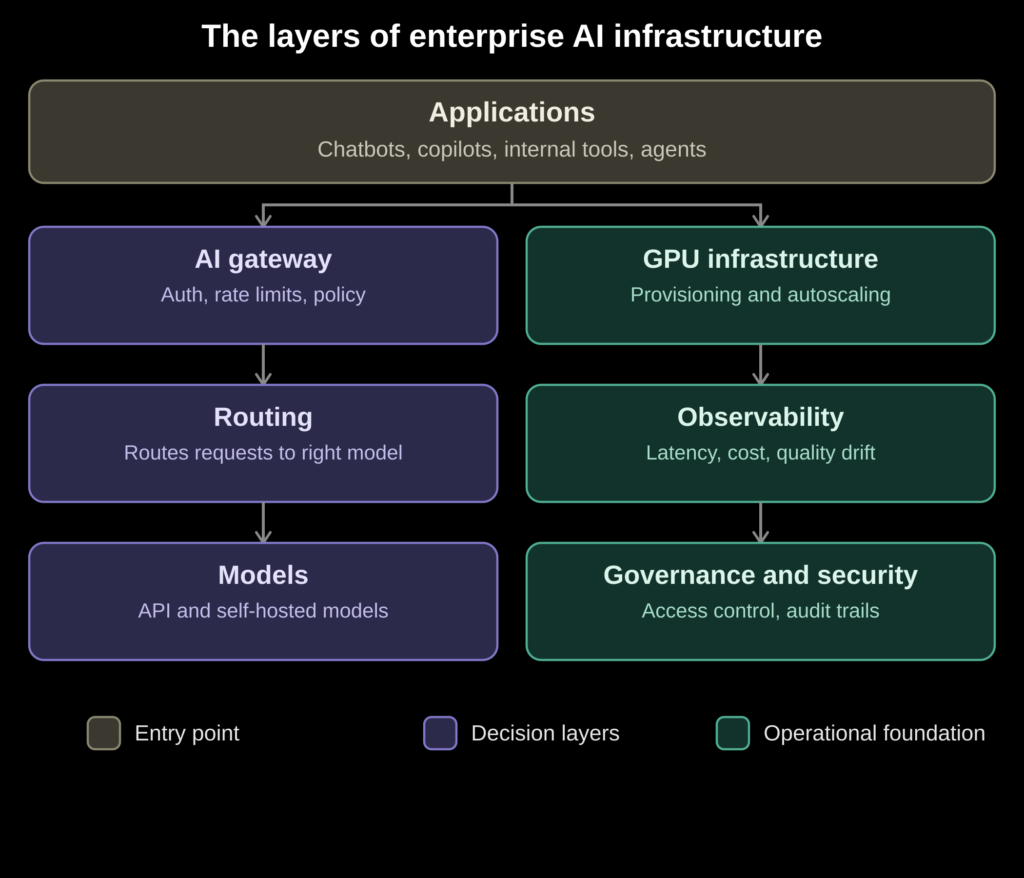
The seven layers of enterprise AI infrastructure, from the application surface down through governance and security.
Why AI Infrastructure Looks Like Cloud Infrastructure Did Fifteen Years Ago
Before cloud computing standardized around a small number of providers and well-understood patterns, companies ran their own physical servers, and every team solved provisioning, scaling, and reliability in its own way. It was slow, expensive, and inconsistent , until infrastructure itself became a coherent discipline with its own tooling, and cloud providers abstracted the mess away.
Enterprise AI today looks a lot like infrastructure did in that earlier era. The model landscape alone includes multiple frontier API providers plus a growing set of capable open-weight models, each with different pricing, context limits, and strengths. Every team that wants to use AI is currently solving the same problems independently: which model for which task, how to control cost, how to monitor quality, how to satisfy a compliance review — usually without talking to the team next door solving the identical problem.
That fragmentation is exactly the condition that produced the cloud infrastructure industry the first time around. Someone has to sit between the raw capability (compute then, models now) and the teams trying to use it, and turn ad hoc, duplicated effort into a shared, governed platform. That’s not a feature request — it’s the same evolutionary step infrastructure took the last time a new computing paradigm arrived faster than the organizational tooling to manage it.
The Rise of AI FinOps and AI Operations
A second, related discipline is emerging alongside the infrastructure layers themselves: the operational practice of actually running AI systems day to day. This covers routing decisions, cost visibility, prompt and context management, audit logging, workload isolation, and the full deployment lifecycle from staging to production to deprecation.
Cost visibility in particular has become its own emerging specialty , often called AI FinOps , because token-based billing, agentic workflows, and multi-model routing make AI spend far harder to attribute and forecast than traditional software costs. (We’ve written separately about why token-based pricing specifically creates budget risk at production scale, and what the actual cost math looks like when you compare metered API pricing against owned infrastructure.)
The organizations building this operational muscle now are the ones treating AI the way mature engineering teams treat any other critical production system: with monitoring, budgets, ownership, and a lifecycle, not as a one-off feature ship.
The Platform Every Enterprise Will Eventually Need
Put the layers and the operational discipline together, and a clear shape emerges: enterprises don’t need another single AI feature. They need a platform that gives them multi-model flexibility, hybrid deployment (some workloads self-hosted, some via API, based on cost and sensitivity), observability, governance, and cost transparency , as a foundation other teams build on top of, rather than something every team rebuilds from scratch.
This is not a hypothetical future state. It’s the same infrastructure maturity curve every previous computing shift has followed, compressed into a much shorter timeline because the underlying capability (the models) is advancing faster than any single organization’s ability to build custom tooling around it.
The companies that get ahead of this aren’t necessarily the ones with the smartest models , everyone has access to roughly the same frontier options. They’re the ones that build the infrastructure layer once, well, and let every team benefit from it instead of solving the same five problems independently, one pilot at a time.
This is the first in a series on enterprise AI infrastructure. For a closer look at one specific piece of this stack : why token-based pricing creates outsized budget risk at production scale, and what the real cost math looks like : see “Why Token-Based AI Pricing Is a Ticking Time Bomb for Enterprise Budgets.”
Sources
-
- McKinsey, The State of AI survey, 2025 — enterprise AI and generative AI adoption figures
- MIT Project NANDA, The GenAI Divide, 2025 — enterprise generative AI pilot failure rate and root-cause findings
- Reporting on enterprise AI rollback and deployment case studies (Starbucks inventory system, customer-facing agent rollbacks), as covered in 2026 enterprise AI spending analyses