
If your compliance calendar still says “EU AI Act: full high-risk obligations due August 2, 2026,” it’s out of date, but not in the direction most vendor content is telling you.
Over the past several weeks, the EU significantly revised a meaningful chunk of its own timeline. Some of what everyone has been racing toward for two years just moved by sixteen months. Some of it didn’t move at all. Getting the difference wrong, in either direction, is the actual risk right now, more than the deadline itself.
What Changed, and When
Following political agreement between Parliament and Council in May, approval by Parliament in June, and formal Council adoption later that month, the amendments are now awaiting publication in the Official Journal of the European Union, the final procedural step before they take legal effect.
That publication is widely expected in the remaining weeks before August 2. Assuming publication proceeds as expected, organizations should prepare on the basis of the following revised timetable:
Deferred to December 2, 2027: full compliance obligations for standalone high-risk AI systems under Annex III. This is the category most enterprises have spent two years bracing for: AI used in hiring and recruitment, credit and creditworthiness scoring, education and vocational training, access to essential public and private services, law enforcement, migration and border control, and the administration of justice. Conformity assessments, technical documentation, risk-management systems, and human-oversight architecture for these systems now have until December 2027, not August 2026: a sixteen-month extension.
Deferred to August 2, 2028: high-risk AI embedded in already-regulated products, such as medical devices, machinery, and other categories covered by existing EU product-safety legislation (Annex I).
Deferred to August 2, 2027: the requirement for each EU member state to operate at least one national AI regulatory sandbox.
New, effective December 2, 2026: a prohibition, added to Article 5, on AI systems designed to generate non-consensual intimate imagery (“nudifier” tools) or child sexual abuse material. This applies to both providers placing such systems on the market and deployers using them.
AI Act Compliance Timeline at a Glance
| Date | What Happens |
|---|---|
| August 2, 2026 | Article 50 transparency obligations take effect; GPAI enforcement powers and market surveillance authority activate |
| December 2, 2026 | New Article 5 prohibition on non-consensual intimate imagery and CSAM-generating systems; watermarking grace period ends for pre-existing systems |
| December 2, 2027 | Annex III high-risk system obligations take effect (deferred from August 2026) |
| August 2, 2028 | Annex I high-risk obligations take effect for AI embedded in already-regulated products |
What Did Not Move
This is the part that’s easy to miss if a headline just tells you “the EU delayed the AI Act.”
Article 50 transparency obligations are still due August 2, 2026, as originally scheduled. These are primarily transparency obligations, disclosure and labeling requirements, rather than the comprehensive governance regime Annex III imposes, and that distinction matters for how much work is actually required by this date versus next year. Article 50 covers disclosure requirements for AI systems that interact directly with people (a chatbot has to identify itself as AI), labeling of AI-generated or manipulated content, and deepfake disclosure. The one narrow exception: the specific sub-obligation requiring machine-readable watermarking of synthetic content (Article 50(2)) gets a grace period until December 2, 2026, but only for systems already placed on the market before August 2, 2026. Anything newly deployed after that date still needs it from day one.
Obligations for general-purpose AI (GPAI) model providers are unaffected. These have technically applied since August 2, 2025, but August 2, 2026 is when the European Commission’s actual supervision and enforcement powers over GPAI providers (the ability to request documentation, conduct evaluations, demand corrective measures, and impose fines) come online.
The full market surveillance and enforcement infrastructure activates August 2, 2026, regardless of the Annex III deferral. Based on current reporting, national market surveillance authorities are set to gain the legal standing to investigate, demand documentation, order market withdrawals, and impose fines for the full range of obligations that have been building since February 2025, not just the parts that didn’t get deferred. The precise scope of these powers is worth confirming against the final published text once it appears in the Official Journal.
In other words: the “big” high-risk category most companies were dreading has received additional implementation time. The transparency, disclosure, and GPAI enforcement machinery did not, and it turns on in a few weeks. Regulators will have real enforcement powers in place well before most organizations are subject to the deferred Annex III requirements.
Why the Deferral isn’t a Reason to Slow Down
Every law firm tracking this closely is saying a version of the same thing: treat the extra time on Annex III as a planning horizon, not a pause button. Two reasons this matters in practice:
First, the systems and vendors you’re already running haven’t stopped needing governance just because the enforcement date moved. Risk classification, documentation, and audit-trail work don’t get faster later; the underlying technical debt is the same whether the deadline is 2026 or 2027.
Second, harmonized standards and detailed implementation guidance for the high-risk categories are still being finalized well into 2026; the Commission’s own consultation on high-risk classification guidelines was only extended through July 23, 2026. Waiting for total clarity before starting means starting with almost no runway once the guidance actually lands, deferral or not.
What This Means in Practice: Where the Audit Trail Actually Lives
Understanding which obligations have moved is only half the problem. The other question organizations should ask is whether their current AI architecture can produce the evidence those obligations ultimately require.
Strip away the calendar and look at what both the surviving August 2026 obligations and the deferred 2027 ones actually demand at a technical level. Article 50 transparency requires proof a system disclosed itself as AI. Annex III high-risk obligations, whenever they land for a given system, require a risk-management system, technical documentation, human-oversight design, and continuous post-market monitoring. Underneath all of it is the same question a regulator will eventually ask: can you produce the record?
That question exposes a structural problem with how most enterprises run AI today. The standard way most organizations consume a model like Claude or ChatGPT is by calling the vendor’s hosted API directly, without a private enterprise deployment layer in between. To be precise about what the actual risk is here: regulators don’t require audit logs to physically reside inside a customer’s own cloud account. The real issue is control, accessibility, retention policy, completeness, and evidential quality. Many organizations rely primarily on logs retained by their AI provider, which can make evidence collection, retention policy decisions, and audit readiness dependent on a third party’s systems rather than their own. When a regulator or an internal auditor asks for a specific record, that dependency is what determines how quickly and completely it can actually be produced.
To be fair to those vendors: both Anthropic and OpenAI do offer paths that run closer to a customer’s own environment, such as Claude via AWS Bedrock or Google Vertex, or ChatGPT via Azure OpenAI Service, which can place inference inside the customer’s own cloud tenant, although these options generally require additional architectural decisions and enterprise agreements that many organizations have not yet implemented. The default, and the pattern most teams are actually running today, is the direct hosted API, with evidence collection and retention dependent on the vendor’s systems rather than the customer’s own.
This is the actual gap XePlatform is built to close, and it’s worth being specific rather than hand-wavy about it: XePlatform deploys entirely inside your own cloud account (AWS, Azure, or GCP, your choice of region, EU regions included) rather than running your workloads through a shared vendor inference layer. The practical consequence for audit readiness: platform activity can be centrally logged and retained within the customer’s own cloud environment, and the architecture supports end-to-end traceability from the start, rather than depending on a third party’s retention policy and format. Compliance isn’t a policy promise layered over infrastructure you don’t control; it’s a property of where the infrastructure actually sits.
To be precise about what that does and doesn’t mean: XePlatform doesn’t hold compliance accreditations on your behalf, and it can’t; the accreditation responsibility stays with your organization, as it should. What changes is the foundation underneath that work. Producing evidence for a regulator becomes a query against your own systems instead of a request to a vendor, and that difference compounds every time a new obligation comes into force, whether that’s this August or December 2027.
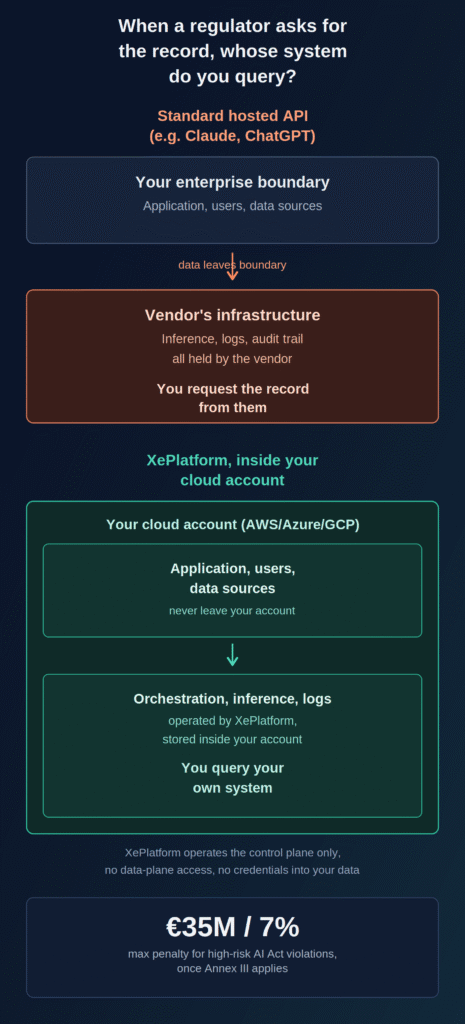
The figure worth sitting with: penalties for high-risk AI system violations run up to €35 million or 7% of global annual turnover, whichever is higher, once Annex III obligations apply to a given system. GPAI and transparency violations under Article 50 carry penalties of up to €15 million or 3% of global turnover, live from August 2, 2026, regardless of the Annex III deferral.
What Organizations Should Do Now
- Confirm whether any currently deployed systems fall under Article 50’s transparency and disclosure requirements, and check readiness against the August 2, 2026 date specifically.
- Review general-purpose AI provider obligations and documentation, since GPAI enforcement powers activate on the same date regardless of the Annex III deferral.
- Continue Annex III governance preparation rather than pausing it. The extra time is a planning horizon, not a reason to stand down.
- Ensure audit evidence can be produced independently of third-party providers, or at minimum, understand exactly what depending on a provider’s retention policy actually means for response time if a regulator asks.
- Monitor Official Journal publication of the Digital Omnibus amendments, since that is the actual trigger date for the revised timetable becoming legally binding, not the Council’s June 29 adoption.
Whatever the calendar says this year or next, the practical test a regulator will apply is the same one a CISO should already be asking internally: if asked today, could you produce the record, and whose system would you have to ask? The implementation timetable may have shifted, but the underlying governance challenge has not. Whether obligations apply this August or next year, organizations that can demonstrate how their AI systems operate, and produce that evidence quickly, will be in a far stronger position than those relying on documentation assembled after the fact.
This article summarizes publicly available legal and regulatory reporting as of early July 2026 and is provided for general informational purposes. It is not legal advice. The Digital Omnibus on AI has completed the EU’s legislative adoption process but was not yet published in the Official Journal at the time of writing; organizations should confirm current status and obligations with qualified counsel before making compliance decisions.
Sources
- Council of the European Union, press release on the Digital Omnibus on AI political agreement, May 7, 2026
- European Parliament, plenary vote on the Digital Omnibus on AI, June 16, 2026
- Council of the European Union, formal adoption of the Digital Omnibus on AI, June 29, 2026
- Gibson Dunn, “EU AI Act Omnibus Agreement — Postponed High-Risk Deadlines and Other Key Changes”
- White & Case, “EU agrees Digital Omnibus deal to simplify AI rules”
- European Commission, AI Act Implementation Timeline (artificialintelligenceact.eu / ai-act-service-desk.ec.europa.eu)