Release Engineering at XePlatform
Automation, Stability, Uptime
The Staging-Production Gap
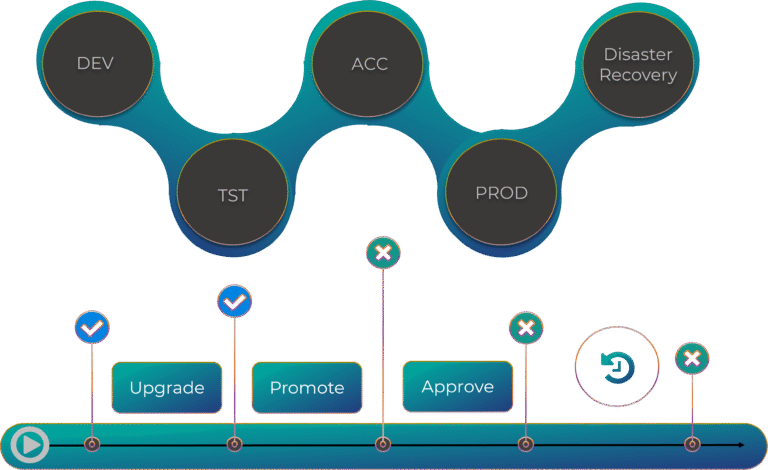
Version mismatches between staging and production environments can lead to catastrophic failures when what worked "perfectly" in staging fails in production due to differences in software versions, dependencies, or configurations.
Misaligned environments break the promise of reliable releases, resulting in costly downtime, eroded trust, and stalled innovation.
Release with Confidence from Code to Production
Why Version Mismatch Hurts
Systems behave differently in staging vs. production, causing unexpected failures that could have been prevented with proper environment parity.
The Cost of Downtime
Average downtime costs $300K per hour, with public outages eroding customer trust and damaging brand reputation.
Innovation Stalled
Teams spend valuable time fixing failures instead of building new features, slowing down product development and competitive advantage.
The Failure Pattern
Most of the production incidents involved uncontrolled version propagation and environment drift, leading to costly failures. The common threads include:
Environment Drift
Staging & Production environments diverge silently over time, creating unexpected differences.
Hidden Dependencies
Untested OS/library changes introduce vulnerabilities that only manifest in production.
Human Error
Mislabeled updates or rushed deployments bypass proper testing procedures.
Toolchain Gaps
Third-party tools assume compatibility without proper validation mechanisms.
Inconsistent Configuration Management
Managing configs with multiple tools or teams can cause sync issues, leading to hidden mismatches and failures.
Undocumented Hotfixes
Manual production fixes bypass testing and version control, causing inconsistencies and long-term fragility.
The Prevention Playbook of XePlatform
Lock Versions
Pin all dependencies to ensure consistency across environments
Deploy Gradually
Use Canary rollouts to minimize blast radius of potential issues
Automated Checks
Validate versions in CI/CD pipelines to catch issues early
Preventing costly tech debt and 3AM alerts
FAQ
What is XePlatform?
An all-in-one Kubernetes-based container platform that streamlines infrastructure provisioning, release automation, and observability. Designed for high-traffic systems and AI-powered workloads, it delivers scalability and efficiency through unified tools. . With our patent-pending release engineering tool, teams can seamlessly deploy microservices across staging and production environments, ensuring faster delivery cycles with enterprise-grade reliability.
How does XePlatform handle AI and LLM workloads?
XePlatform automatically scales compute (CPU, GPU) on demand—ideal for training and serving LLMs at scale. CI/CD pipelines support automated deployments, version control, and rollbacks—critical for fast model iteration. Observability provides real-time monitoring, drift detection, and alerting for AI models in production.
Can XePlatform support massive traffic and performance demands?
Absolutely. With Kubernetes-native autoscaling and fault-tolerant design, it ensures high availability—even under heavy load. Ideal for latency-sensitive or bursty AI inference and high user volume environments.
Does XePlatform ensure AI data and model sovereignty?
Yes. It supports private, or sovereign deployments in cloud without relying on third-party APIs or vector stores. You retain full control over data, LLMs, and inference environments for maximum security and compliance.
How does XePlatform ensure separation of concerns?
XePlatform requires only your container image; it doesn’t touch your actual codebase. Infrastructure provisioning and release workflows are managed through declarative configurations (e.g., IaC, GitOps) that are separate from application code—maintaining clean boundaries and preserving code ownership.
How Secure is XePlatform?
XePlatform follows industry-best practices for security. Role-Based Access Control (RBAC) ensures only authorized users can access resources. All infrastructure and application configurations are stored securely in version-controlled repositories.Continuous monitoring helps detect and respond to security incidents proactively.
How does XePlatform support sovereignty in AI deployments?
XePlatform enables full AI sovereignty by allowing you to:
Run LLMs privately with no reliance on external APIs.
Keep vector databases self-hosted, ensuring embeddings and data remain within your infrastructure.
Avoid data sharing with third-party AI providers, unlike managed AI platforms.
Deploy on-prem or in sovereign clouds, with full control over data, compute, and compliance.
This ensures sensitive workloads stay secure, compliant, and under your complete control.
How can I get started with XePlatform?
Getting started is easy!
- Step 1: Contact us to schedule a demo.
- Step 2: Our onboarding team will guide you through the setup process.
- Step 3: Begin provisioning infrastructure, managing releases, and monitoring performance within hours!
What makes XePlatform ideal for sustainable, high-scale deployments?
Beyond performance, XePlatform is a green-friendly solution:
Dynamically scales compute to match demand
Prevents idle capacity
Reduces energy and cooling footprint
Extends infrastructure life and minimizes waste
What about GPU efficiency—can XePlatform avoid underutilized GPUs?
Absolutely. XePlatform features right-sized GPU orchestration and serverless GPU provisioning that scale resources in real time. This avoids overprovisioning while maximizing utilization—even during high-volume AI workloads

Stay Updated with the Latest Platform Engineering Trends
Subscribe to our newsletter and never miss out on the newest developments in Platform Engineering