Artificial Intelligence has gone through multiple operational revolutions. First, we had DevOps to streamline software delivery. Then came MLOps to manage the complexities of machine learning pipelines. Now, with the rise of large language models (LLMs), we are seeing a new operational paradigm: LLMOps.
So, how exactly does LLMOps differ from MLOps? And where does one end and the other begin?
MLOps: The Training-Focused World
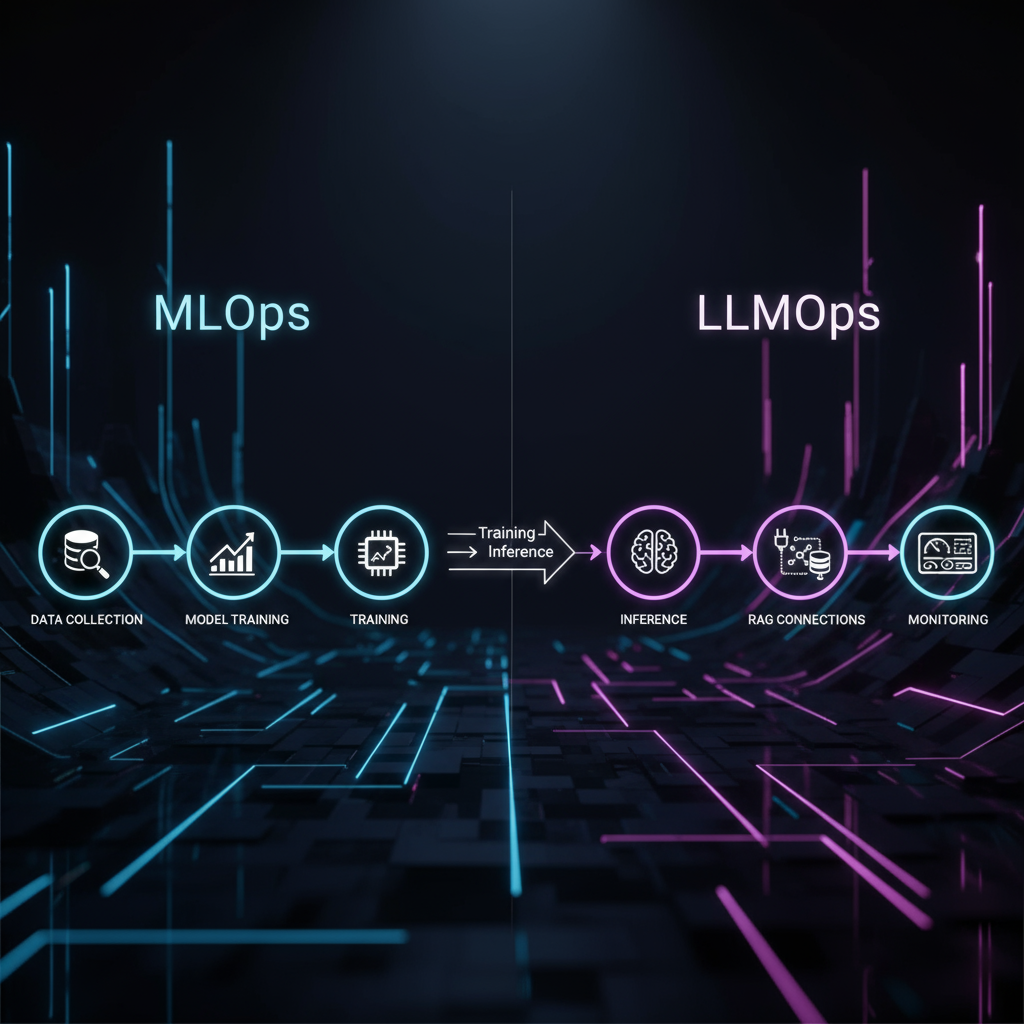
MLOps is all about the end-to-end machine learning lifecycle, with a heavy emphasis on training workflows. Typical steps include:
- Data collection & labeling – Gathering and cleaning datasets.
- Model training & retraining – Building models from scratch or fine-tuning smaller models.
- Experiment tracking – Comparing model versions and performance.
- Deployment & monitoring – Putting models into production and ensuring stability.
The core of MLOps is about making model training repeatable, scalable, and reliable. Think of models like image classifiers or fraud detection systems that need frequent retraining on new data.
LLMOps: The Inference-Focused World
With large language models (Gemma, Llama, Mistral, GPT, etc.), the landscape changes. Training from scratch is expensive and impractical for most teams. Instead, LLMOps is about operationalizing pre-trained models—optimizing inference, enhancing adaptability, and ensuring reliability. Key areas include:
- Model hosting & serving – Efficiently running massive models on GPUs/TPUs.
- Inference optimization – Reducing latency and cost via quantization, batching, and caching.
- PEFT (Parameter-Efficient Fine-Tuning) – Lightweight adaptation without retraining the full model.
- RAG (Retrieval-Augmented Generation) – Connecting LLMs to knowledge bases for up-to-date, domain-specific responses.
- Monitoring & evaluation – Tracking hallucinations, bias, toxicity, and usage patterns.
In short, LLMOps is about reliable inference and lightweight customization, not heavy retraining.
Where They Meet: The Handoff Point
A simple way to see it:
- MLOps ends at training.
- LLMOps begins at inference.
When you’re working with custom data pipelines, feature engineering, and retraining models—you’re in MLOps territory. When you’re deploying an LLM, adding RAG for real-time knowledge, fine-tuning with PEFT, and monitoring outputs—you’re in LLMOps territory.
Why This Matters
For businesses, this distinction is critical. Traditional ML workflows won’t disappear, but LLMOps introduces new challenges: scalability, cost control, hallucination reduction, and compliance. Teams that understand where MLOps ends and LLMOps begins can design hybrid workflows that make the most of both.
In fact, using techniques like PEFT + RAG, you’re firmly operating within the LLMOps domain—focusing on inference augmentation and adaptation, not raw model training.
XePlatform provides foundational LLMOps functionalities, such as:
- Model Deployment & Serving: Automating the deployment of LLMs (e.g., GPT, LLaMA, Claude) to production environments (cloud, edge, hybrid) with optimized inference engines.
- Scalability & Resource Management: Handling massive computational demands via auto-scaling, GPU/TPU orchestration, and efficient load balancing.
- Monitoring & Observability: Real-time tracking of model performance, latency, error rates, resource utilization, and cost metrics.
- Versioning & Experimentation: Managing model versions, datasets, prompts,
Final Thoughts
MLOps and LLMOps aren’t competitors—they’re complementary. As AI evolves, many organizations will find themselves running both pipelines side by side. Traditional ML for structured prediction tasks, and LLMOps for natural language and generative applications.
The future belongs to teams that master this distinction and can seamlessly integrate both worlds. XePlatform is considered LLMOps because it provides the infrastructure, automation, and governance required to deploy, manage, and scale large language models reliably in production. It bridges the gap between experimental LLM development and real-world enterprise applications, addressing the unique operational challenges of LLMs . Given that XePlatform emphasizes these areas—especially LLM-specific workflows—it naturally falls under the LLMOps umbrella.
💡 Key takeaway: MLOps is training-centric. LLMOps is inference-centric. Together, they power the next generation of AI applications.